Real Time Monitoring
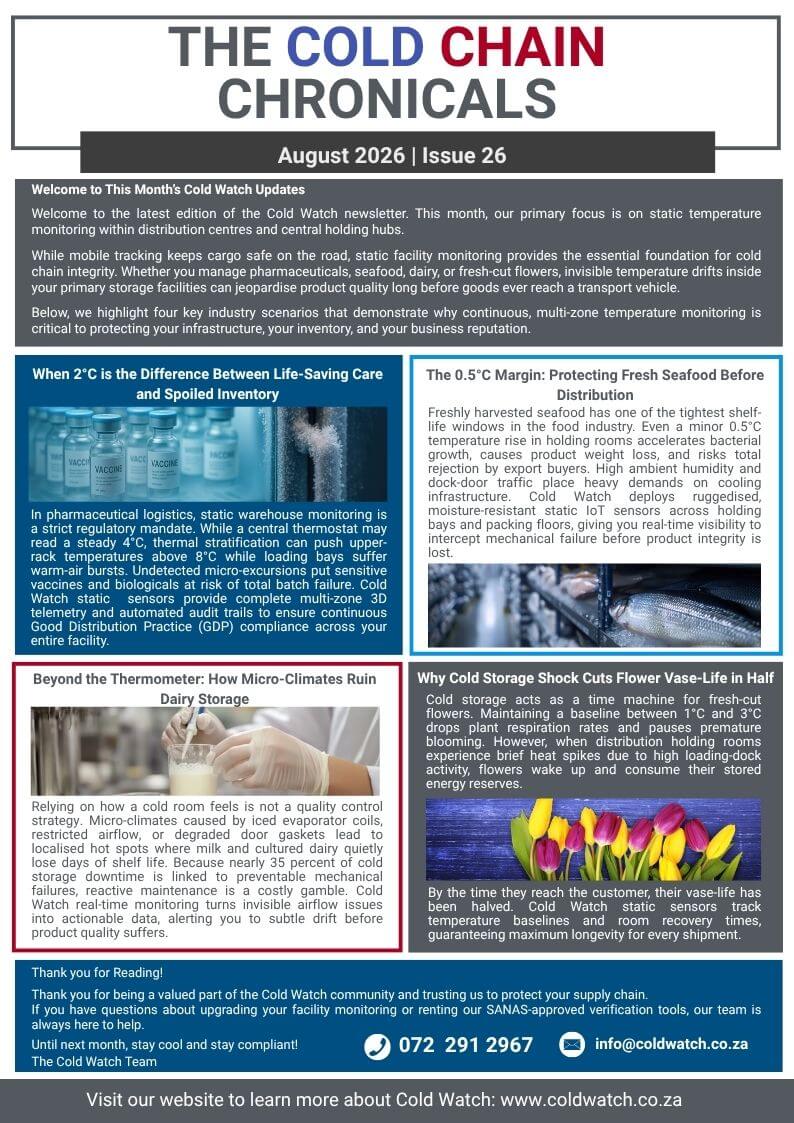
The Cold Chain Chronicals | August 2026 | Issue 26
Welcome to This Month’s Cold Watch Updates
Welcome to the latest edition of the Cold Watch newsletter. This month, our primary focus is on static temperature monitoring within distribution centres and central holding hubs.
While mobile tracking keeps cargo safe on the road, static facility monitoring provides the essential foundation for cold chain integrity. Whether you manage pharmaceuticals, seafood, dairy, or fresh-cut flowers, invisible temperature drifts inside your primary storage facilities can jeopardise product quality long before goods ever reach a transport vehicle.
Below, we highlight four key industry scenarios that demonstrate why continuous, multi-zone temperature monitoring is critical to protecting your infrastructure, your inventory, and your business reputation.
When 2°C is the Difference Between Life-Saving Care and Spoiled Inventory
In pharmaceutical logistics, static warehouse monitoring is a strict regulatory mandate. While a central thermostat may read a steady 4°C, thermal stratification can push upper-rack temperatures above 8°C while loading bays suffer warm-air bursts. Undetected micro-excursions put sensitive vaccines and biologicals at risk of total batch failure. Cold Watch static sensors provide complete multi-zone 3D telemetry and automated audit trails to ensure continuous Good Distribution Practice (GDP) compliance across your entire facility.
Beyond the Thermometer: How Micro-Climates Ruin Dairy Storage
Relying on how a cold room feels is not a quality control strategy. Micro-climates caused by iced evaporator coils, restricted airflow, or degraded door gaskets lead to localised hot spots where milk and cultured dairy quietly lose days of shelf life. Because nearly 35 percent of cold storage downtime is linked to preventable mechanical failures, reactive maintenance is a costly gamble. Cold Watch real-time monitoring turns invisible airflow issues into actionable data, alerting you to subtle drift before product quality suffers.
The 0.5°C Margin: Protecting Fresh Seafood Before Distribution
Freshly harvested seafood has one of the tightest shelf-life windows in the food industry. Even a minor 0.5°C temperature rise in holding rooms accelerates bacterial growth, causes product weight loss, and risks total rejection by export buyers. High ambient humidity and dock-door traffic place heavy demands on cooling infrastructure. Cold Watch deploys ruggedised, moisture-resistant static IoT sensors across holding bays and packing floors, giving you real-time visibility to intercept mechanical failure before product integrity is lost.
Why Cold Storage Shock Cuts Flower Vase-Life in Half
Cold storage acts as a time machine for fresh-cut flowers. Maintaining a baseline between 1°C and 3°C drops plant respiration rates and pauses premature blooming. However, when distribution holding rooms experience brief heat spikes due to high loading-dock activity, flowers wake up and consume their stored energy reserves.
By the time they reach the customer, their vase-life has been halved. Cold Watch static sensors track temperature baselines and room recovery times, guaranteeing maximum longevity for every shipment.
Thank you for Reading!
Thank you for being a valued part of the Cold Watch community and trusting us to protect your supply chain.
If you have questions about upgrading your facility monitoring or renting our SANAS-approved verification tools, our team is always here to help.
Until next month, stay cool and stay compliant!
The Cold Watch Team